Every business wants to save money.
That’s not a mistake.
It’s simply good business.
Investing carefully.
Reducing unnecessary costs.
Maximising return.
These are qualities of successful companies.
But sometimes…
The cheapest decision becomes the most expensive one.
Few investments demonstrate that more clearly than a business website.
Every year, thousands of companies choose the lowest quote.
A cheaper agency.
A freelancer.
A website builder.
A ready-made template.
At first, everything seems fine.
The website goes live.
The business saves several thousand euros.
Problem solved.
Until the hidden costs begin to appear.
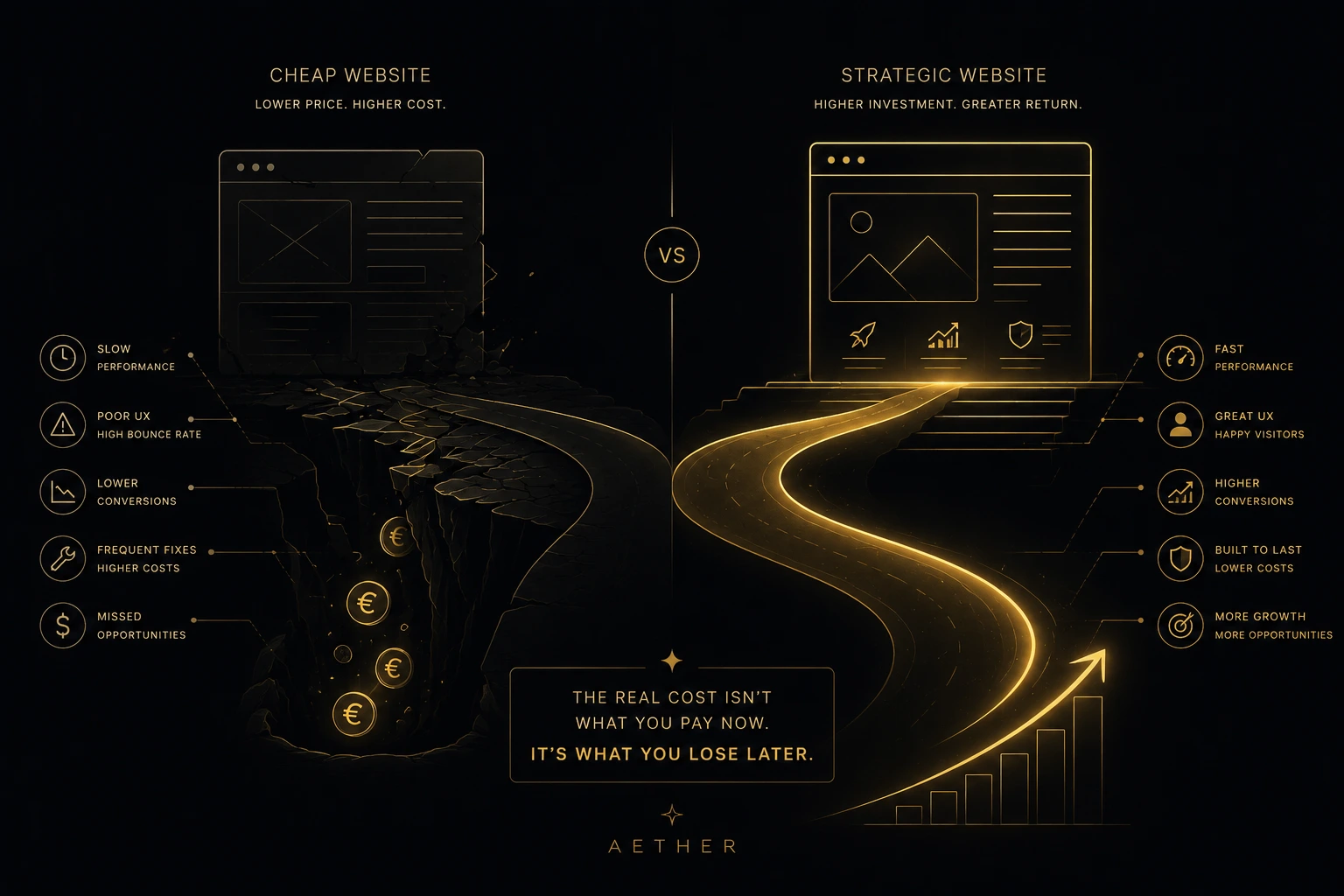
Slow performance.
Poor conversions.
Limited flexibility.
Constant maintenance.
Missed opportunities.
Eventually the business pays for the website twice.
Once to build it.
And again to replace it.
The real cost of a cheap website is rarely visible on the invoice.
It’s visible in everything that happens afterwards.
The Cheapest Website Is Rarely the Least Expensive
Price and value are not the same thing.
A €700 website may appear less expensive than a €7,000 website.
But websites should never be evaluated by purchase price alone.
They should be evaluated by the value they create over time.
A website isn’t simply another business expense.
It’s one of your most important business assets.
It represents your brand.
Generates enquiries.
Supports marketing.
Builds trust.
Explains your services.
Works for your business every hour of every day.
Viewed over five or ten years, the initial development cost often becomes the smallest part of the investment.
The true question isn’t:
“How much does this website cost?”
It’s:
“How much value will this website create?”
Cheap Websites Usually Cost Time Instead of Money
Many businesses believe they’re saving money.
In reality, they’re often exchanging money for time.
Hours spent fixing problems.
Searching for plugins.
Updating themes.
Trying to improve performance.
Replacing broken integrations.
Working around limitations that never should have existed.
None of those costs appear on the original quotation.
But they accumulate quietly over the years.
Eventually the business owner spends more time managing the website than benefiting from it.
A good website should reduce workload.
Not create more of it.
The Hidden Cost of Lost Trust
Not every business loss appears in accounting software.
Some losses are impossible to measure precisely.
The customer who leaves before reading your services.
The potential client who never submits the contact form.
The visitor who quietly chooses a competitor.
Most businesses never know these opportunities existed.
They simply disappear.
As we explored in The Psychology Behind High-Converting Websites, trust is built through dozens of small interactions.
A slow page.
Confusing navigation.
Outdated design.
Unclear messaging.
Each one introduces a little more uncertainty.
Together they reduce confidence.
And confidence is often the deciding factor between winning a customer and losing one.
Technical Debt Becomes Business Debt
Many inexpensive websites are built as quickly as possible.
Not necessarily as sustainably as possible.
Extra plugins compensate for missing functionality.
Page builders generate unnecessary code.
Updates become increasingly risky.
Performance gradually declines.
The website becomes more difficult to maintain every year.
Developers describe this accumulation of shortcuts as technical debt.
Businesses experience it differently.
Delayed projects.
Higher maintenance costs.
Growing frustration.
Missed opportunities.
Technical debt eventually becomes business debt.
The longer it’s ignored, the more expensive it becomes.
As we explained in Why a Custom WordPress Website Beats Any Template, websites designed for long-term growth rarely need to be rebuilt from scratch every few years.
Cheap Websites Often Create Digital Friction™
The biggest cost of a cheap website isn’t always visible.
It’s experienced.
Visitors wait slightly longer.
Navigation feels less intuitive.
Pages become cluttered.
Calls-to-action appear too early.
Information is difficult to find.
None of these problems seem dramatic on their own.
Together, they create resistance.
At Bureau AETHER, we call this Digital Friction™.
Digital Friction™ quietly slows every customer journey.
It increases mental effort.
Interrupts momentum.
Weakens confidence.
As we explored in Why Beautiful Websites Still Fail, visitors don’t leave because one thing is wrong.
They leave because dozens of small obstacles quietly accumulate.
A Website Should Generate Return, Not Require Replacement
A successful website shouldn’t be viewed as a finished project.
It should be viewed as an investment.
Like any investment, its value should increase over time.
New content strengthens authority.
Additional services expand opportunities.
Improved user journeys increase conversions.
Performance refinements enhance every interaction.
A well-built website becomes more valuable each year.
A poorly built website usually becomes more expensive each year.
Eventually, many businesses reach the same conclusion.
Maintaining the old website costs more than replacing it.
That’s not because technology failed.
It’s because the original foundation was never designed for long-term growth.
Growth Demands Flexibility
No successful business stands still.
Services evolve.
Markets change.
Customer expectations increase.
Marketing strategies become more sophisticated.
Your website should evolve just as naturally.
Unfortunately, many low-cost websites are built around short-term convenience rather than long-term flexibility.
Adding new functionality becomes increasingly complicated.
Integrations require workarounds.
Landing pages become inconsistent.
Performance gradually declines.
Instead of supporting growth, the website begins limiting it.
Businesses shouldn’t adapt to their website.
The website should adapt to the business.
A Real-World Example
Imagine two engineering firms starting at exactly the same time.
Both invest in a new website.
The first chooses the cheapest available solution.
The second invests in a strategically planned custom website.
During the first year, both websites appear successful.
Clients find the businesses.
Projects are completed.
Everything works.
Then both companies begin expanding.
The first website struggles to keep up.
Additional functionality requires new plugins.
Performance declines.
Updates introduce compatibility issues.
Marketing campaigns require landing pages the website wasn’t designed to support.
The second website evolves differently.
Its architecture already anticipated future growth.
New services fit naturally into the existing structure.
Performance remains consistent.
The website continues supporting the business instead of slowing it down.
Five years later, the difference isn’t measured by the original development cost.
It’s measured by everything that happened afterwards.
The AETHER Perspective
At Bureau AETHER, we don’t believe businesses should spend more money simply for the sake of spending more money.
We believe they should invest where long-term value is created.
Sometimes a template is exactly the right solution.
Sometimes a custom website becomes the smarter investment.
The difference isn’t determined by budget.
It’s determined by ambition.
Every website we develop begins with one question.
Where does this business want to be five years from now?
That answer shapes every technical and strategic decision.
As we explored in Why a Custom WordPress Website Beats Any Template, sustainable growth requires a flexible foundation.
In Why Website Speed Matters More Than Ever, we demonstrated how performance influences trust long before visitors make a decision.
And in What Is Artificial Intelligence Optimization (AIO)?, we explained why modern websites must increasingly communicate with both people and artificial intelligence.
Those ideas come together in every website we build.
Not because they’re trends.
Because they’re the foundations of sustainable digital growth.
Conclusion & Final Thought
Cheap websites aren’t expensive because of what they cost today.
They’re expensive because of what they prevent tomorrow.
Every delay.
Every workaround.
Every missed opportunity.
Every unnecessary redesign.
Every lost customer.
Those costs rarely appear on an invoice.
But they accumulate over time.
A website shouldn’t simply help your business exist online.
It should actively help your business grow.
The cheapest website is rarely the one that costs the least.
The most valuable website is the one that continues creating value long after launch.
If you’re ready to invest in a website designed for long-term growth instead of short-term savings, explore our Custom Website Development services or discover how our SEO & AIO strategy helps businesses build digital foundations that remain valuable for years to come.