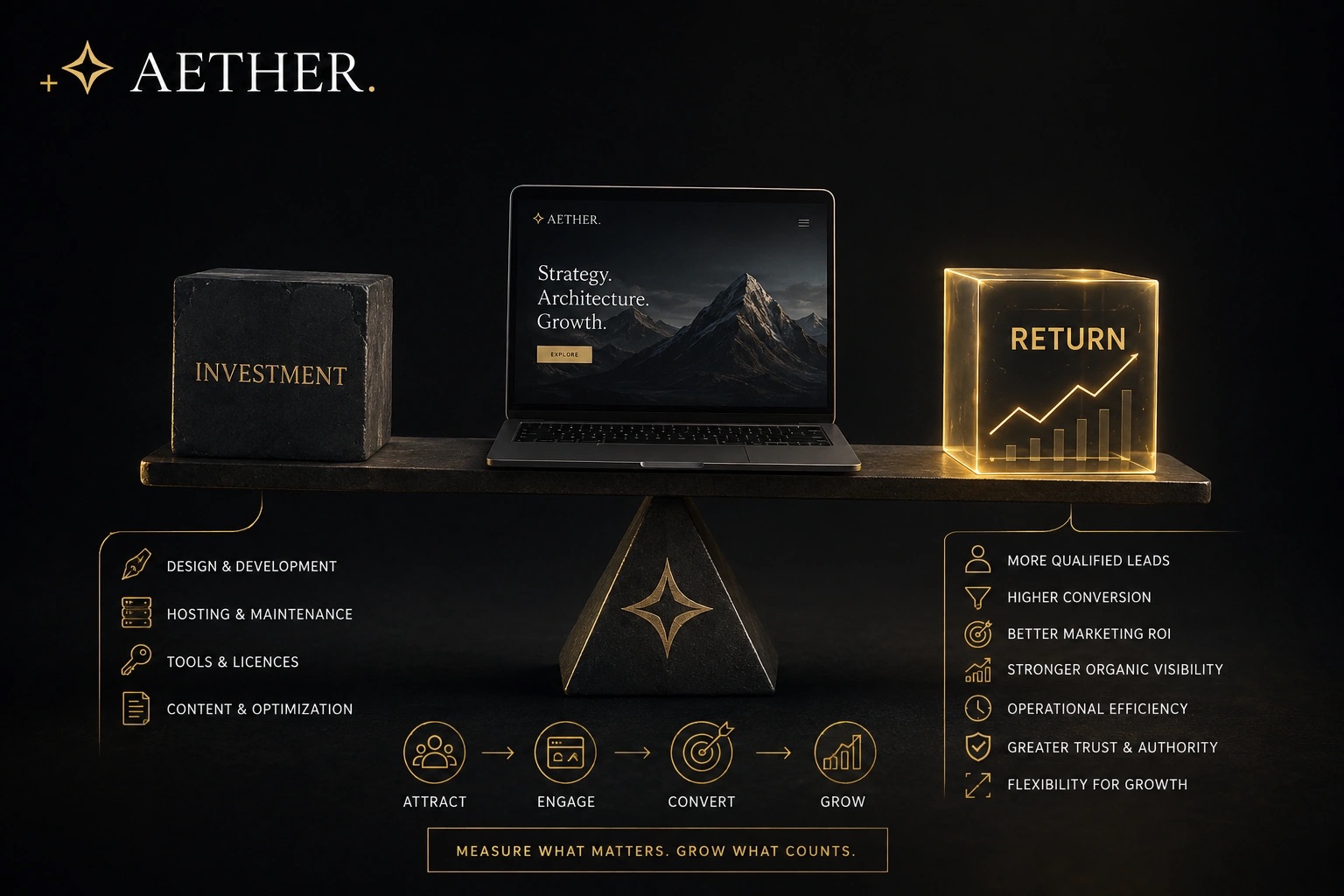
A professional website is an investment.
But investments should be measured.
Not only by what they cost.
By what they create.
This is where many businesses struggle.
They know what they paid for the website.
They know the monthly hosting cost.
They know the maintenance budget.
But they often cannot answer a much more important question:
“What is this website actually worth to the business?”
That is the foundation of website ROI.
Return on investment is not simply about whether the website generated enough direct sales to cover the build cost.
For many businesses, the value is broader.
More qualified enquiries.
Higher conversion rates.
Lower acquisition costs.
Better performance from paid campaigns.
Stronger organic visibility.
Shorter sales cycles.
Less manual work.
Greater trust.
More flexibility for future growth.
All of these outcomes can contribute to return.
So the real question is not:
“Did the website pay for itself?”
It is:
“How much business value did the website create compared with what it cost to build and operate?”
Start With the Basic ROI Formula
The simplest website ROI formula is:
(Value Generated – Website Cost) / Website Cost × 100
If a website costs €10,000 and creates €30,000 in measurable value, the calculation becomes:
(€30,000 – €10,000) / €10,000 × 100 = 200% ROI
Simple.
Useful.
But incomplete.
The difficulty is not the formula.
The difficulty is determining what belongs under Value Generated.
For an e-commerce business, revenue may be relatively easy to attribute.
For a consultancy, law firm, construction company or B2B service provider, the website may influence the sale without completing it directly.
A visitor discovers the company through search.
Reads several articles.
Reviews a case study.
Returns two weeks later.
Then contacts the sales team.
The website contributed to the outcome even though no online checkout occurred.
That means website ROI should be measured around the role the website actually plays in the customer journey.
Lead Generation Is Often the Clearest Starting Point
For service businesses, leads are one of the easiest forms of website value to measure.
Start with three numbers.
How many qualified leads does the website generate?
What percentage become customers?
What is the average value of a new customer?
Imagine a website generates 20 qualified enquiries per month.
25% become customers.
The average first-year customer value is €4,000.
That means the website is contributing approximately five new customers per month.
Or €20,000 in first-year customer value.
Over twelve months, that becomes €240,000.
That does not mean every euro should automatically be attributed to the website.
The sales team still matters.
The service quality matters.
The brand matters.
Other marketing channels may have contributed.
But the calculation immediately gives the business a better understanding of the commercial role the website plays.
This is also why a website should not be evaluated purely through traffic.
Ten thousand visitors who generate no qualified opportunities can be less valuable than one thousand visitors who consistently become customers.
Conversion Rate Can Change Website ROI Without Increasing Traffic
Businesses often assume more return requires more traffic.
It does not.
Sometimes the fastest way to increase website ROI is to create more value from the visitors you already have.
Imagine a website receives 5,000 relevant visitors per month.
At a 1% conversion rate, it generates 50 enquiries.
Improve that conversion rate to 2% and the same traffic generates 100 enquiries.
No additional advertising budget.
No additional organic traffic.
The website simply becomes more effective at turning existing attention into action.
This is where UX Architecture™ and Decision Architecture™ become commercially measurable.
Clearer navigation.
Better service explanations.
Stronger proof.
Reduced cognitive load.
Better calls to action.
Less Digital Friction™.
Each improvement can increase the value generated from the same traffic base.
That means conversion improvement is not only a UX metric.
It is an ROI metric.
Paid Advertising Makes Website ROI Even More Important
Every paid click has a cost.
That means the website receiving that click has a direct influence on marketing efficiency.
Imagine two businesses both spend €5,000 per month on advertising.
Both generate 2,000 relevant visits.
The first website converts 1% of visitors.
Twenty leads.
The second converts 3%.
Sixty leads.
The media budget is identical.
The return is not.
This is why Ad Campaigns and website quality cannot be treated as separate systems.
Advertising creates attention.
The website determines how much value is extracted from that attention.
A slow landing page.
Unclear positioning.
Weak trust signals.
Confusing forms.
Each one increases the effective cost of customer acquisition.
As we explored in Why Website Speed Matters More Than Ever, performance problems can quietly reduce the value of every marketing euro sent to the site.
Organic Visibility Creates Compounding Website Value
Paid acquisition stops when the budget stops.
Organic visibility behaves differently.
A useful service page can attract search traffic for years.
A strong article can introduce the business to potential customers long after publication.
A connected knowledge library can strengthen authority across multiple topics.
This creates compounding value.
The initial investment in architecture, content and search foundations continues producing opportunities over time.
This is where SEO & AIO becomes part of the ROI calculation.
Measure organic enquiries.
Organic assisted conversions.
The cost that equivalent paid traffic would require.
Growth in visibility for commercially relevant topics.
And the long-term value of content that continues generating discovery without requiring payment for every click.
In an AI-driven search environment, this measurement may expand further.
A website can create value by becoming a source that helps search engines and AI systems understand the organisation’s expertise.
That value is harder to attribute immediately.
But it still contributes to discoverability and long-term Semantic Authority™.
Website ROI Also Includes Operational Efficiency
A website can create value even when it does not directly generate a sale.
That is especially important for service businesses.
A well-structured website can reduce repetitive questions.
Explain services before a sales conversation.
Qualify enquiries.
Guide customers toward the right solution.
Automate simple processes.
Reduce unnecessary back-and-forth.
Each of these outcomes saves time.
And time has a cost.
If a sales team spends ten fewer hours per month answering basic questions because the website already explains the process clearly, that creates operational value.
If a better form filters out irrelevant enquiries, the sales team spends more time on qualified opportunities.
If customers can book, request information or submit the right details without manual intervention, internal workload decreases.
These improvements may not appear as website revenue.
But they still contribute to return.
A professional website should therefore be measured not only by what it generates.
But also by what it removes.
Manual work.
Unnecessary conversations.
Slow processes.
Repeated explanation.
Operational Digital Friction™.
Trust Has Economic Value Too
Trust is difficult to measure directly.
But that does not make it worthless.
Imagine two businesses offering comparable services.
One website looks outdated, vague and difficult to navigate.
The other is clear, fast, professional and supported by relevant case studies.
Both companies may deliver equally good work.
But potential customers do not know that yet.
They can only evaluate the signals available to them.
A stronger digital experience can reduce uncertainty before the first conversation begins.
That can improve:
Lead quality.
Conversion rates.
Sales confidence.
Price perception.
Brand credibility.
The percentage of prospects who continue researching instead of leaving.
As we explored in The Psychology Behind High-Converting Websites, people often act when enough uncertainty has been removed.
Trust reduces that uncertainty.
And when trust increases the likelihood of a commercial outcome, it contributes to ROI even when it cannot be isolated perfectly inside analytics.
Do Not Ignore the Cost of Maintaining the Website
Return should never be calculated using development cost alone.
The website also has an operating cost.
Hosting.
Maintenance.
Licences.
Development support.
Content production.
Performance optimisation.
Security.
Future improvements.
These costs belong in the investment side of the equation.
But there is another cost that is often ignored:
the cost of change.
A website that requires extensive development every time the business changes may produce a weaker long-term return than a platform that is initially more expensive but easier to evolve.
This is exactly where technical debt becomes financially relevant.
If every improvement becomes slower and riskier, the website consumes more resources over time.
If the architecture remains flexible, future investment can be directed toward growth instead of repairing the foundation.
That difference should be part of any serious ROI analysis.
A Real-World Example
Imagine a B2B consultancy investing €15,000 in a new website.
The previous website generated ten qualified enquiries per month.
The new website generates sixteen.
The sales team converts 25% of qualified enquiries into customers.
The average first-year customer value is €6,000.
The six additional monthly enquiries create approximately 1.5 additional customers per month.
That represents around €9,000 in additional first-year customer value every month.
Or approximately €108,000 per year.
But the website creates additional value too.
Organic traffic increases.
Paid campaigns convert more efficiently.
Prospects arrive better informed.
The sales team spends less time explaining basic services.
The marketing team can create landing pages internally instead of requesting development support.
The €15,000 investment did not only generate more leads.
It improved several systems around those leads.
Even after allowing for ongoing maintenance and marketing costs, the return can significantly exceed the original investment.
This is why Website Cost vs Website Value is such an important distinction.
Cost is visible on day one.
Value accumulates afterwards.
The AETHER Perspective
At Bureau AETHER, we believe website ROI should begin with the role the website needs to play.
Not every website should be judged by the same metric.
An e-commerce website may focus heavily on revenue and conversion rate.
A B2B website may prioritise qualified leads and sales efficiency.
A knowledge-driven business may measure organic visibility, authority and assisted conversions.
A recruitment platform may create value through applications and reduced administrative work.
The metric should follow the objective.
That is why our Custom Website Development process starts by understanding what commercial outcome the website is supposed to improve.
Then the architecture, UX, content and technology can be designed around that outcome.
ROI becomes much easier to measure when success was defined before the website was built.
The goal is not to create the most expensive digital platform.
It is to create a platform where the value generated over time is meaningfully greater than the cost required to build and operate it.
Conclusion & Final Thought
Website ROI is not a single analytics number.
It is the relationship between investment and business value.
Direct revenue matters.
Leads matter.
Conversion matters.
Marketing efficiency matters.
Organic visibility matters.
Operational efficiency matters.
Trust matters.
And the future cost of maintaining the platform matters too.
The strongest ROI analysis combines these outcomes instead of looking at the website in isolation.
A website should not be judged by how much it cost to launch.
It should be judged by how much value it continues creating after launch.
If your current website is difficult to evaluate because its commercial role was never clearly defined, explore our Custom Website Development approach and build the next platform around measurable business outcomes from the beginning.