Every second counts.
Not just in sport.
Not just in business.
But on your website.
Most visitors never consciously think about loading speed.
They don’t measure milliseconds.
They don’t analyse performance reports.
They simply experience how your website feels.
Fast websites feel professional.
Slow websites feel uncertain.
That feeling influences every decision visitors make.
Long before they read your content.
Long before they compare your services.
Long before they contact your business.
Website speed is no longer just a technical metric.
It’s part of your brand.
It’s part of your customer experience.
And increasingly…
It’s part of how both search engines and artificial intelligence evaluate your website.
That’s why every second has become more valuable than ever.
Speed Isn’t About Technology. It’s About Human Behaviour.
Imagine walking into a beautifully designed shop.
The products look exceptional.
The lighting is perfect.
The atmosphere feels premium.
But nobody acknowledges your presence.
You wait.
Five seconds.
Ten seconds.
Fifteen seconds.
Eventually you leave.
The shop wasn’t unsuccessful because it looked bad.
It failed because it interrupted momentum.
Websites work exactly the same way.
Every delay interrupts a visitor’s natural flow.
Every unnecessary loading screen creates uncertainty.
Every second gives people another opportunity to leave.
Performance isn’t simply about faster technology.
It’s about protecting attention.
Because attention is one of the most valuable resources any business has.
Digital Friction™ Begins Long Before Visitors Notice It
Most businesses only recognise performance problems when websites become obviously slow.
But friction starts much earlier.
A button that responds just slightly too late.
An oversized image.
An unnecessary animation.
A third-party script loading in the background.
A page builder generating unnecessary code.
Individually these delays appear insignificant.
Together they create resistance.
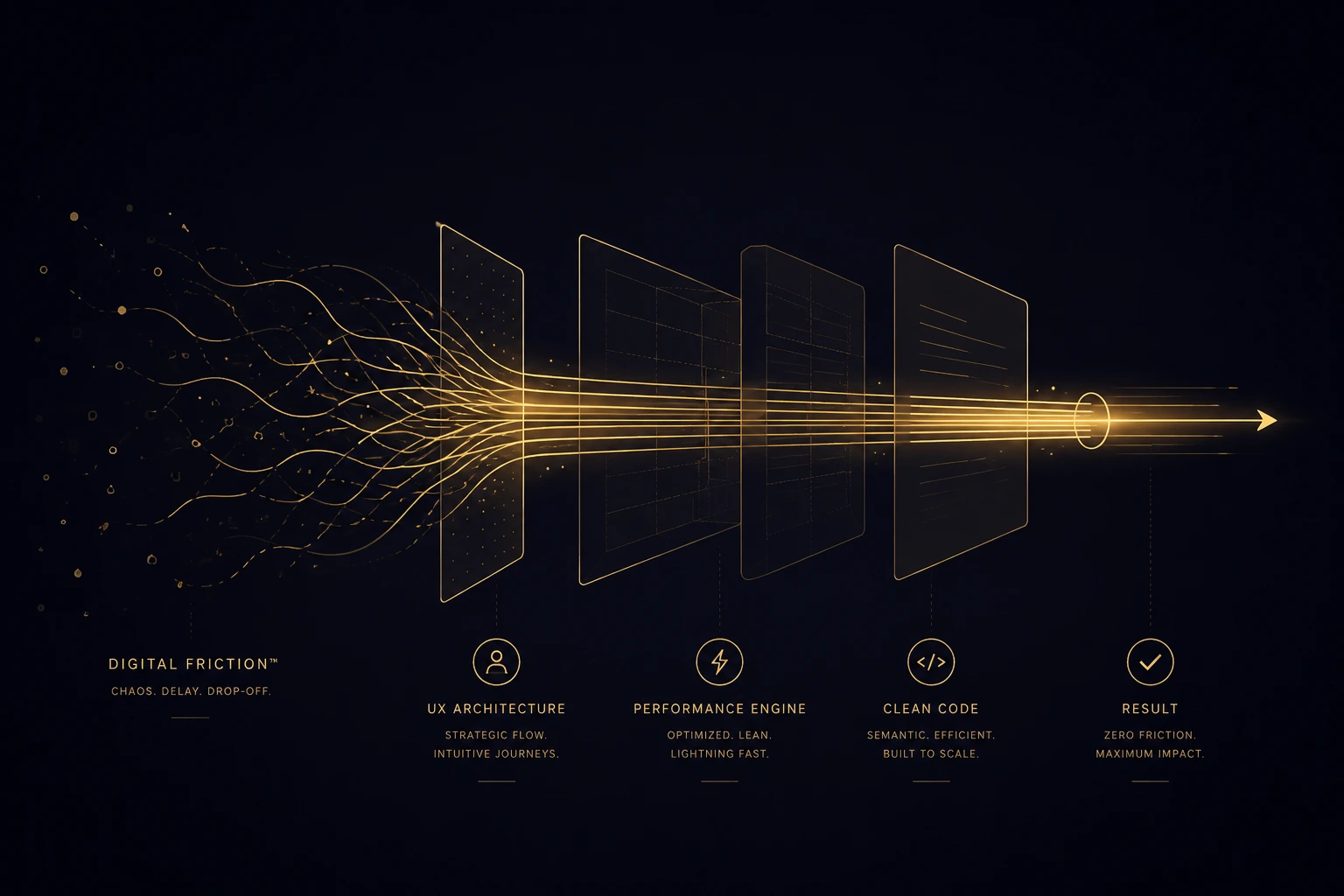
At Bureau AETHER, we describe that resistance as Digital Friction™.
Digital Friction™ is the invisible force that slows visitors down before they consciously realise something feels wrong.
The greater the friction becomes…
The harder every decision feels.
The harder people need to think…
The less likely they are to act.
That’s why website performance should never be viewed as a purely technical responsibility.
It’s a strategic business decision.
Website Speed Directly Influences Trust
Trust isn’t built by one dramatic moment.
It’s built through hundreds of small experiences.
A page loads instantly.
A menu responds immediately.
A form submits without hesitation.
Everything feels effortless.
Visitors rarely notice these moments individually.
They simply conclude that your business feels professional.
The opposite is equally true.
Slow interactions create doubt.
Questions begin to appear.
Is this business still active?
Can I trust this website?
If the website struggles to load…
Will customer service be equally slow?
These thoughts happen almost subconsciously.
As we explored in The Psychology Behind High-Converting Websites, confidence is built through consistency rather than persuasion.
Performance is one of the earliest trust signals visitors experience.
Performance Is a Foundation of Modern UX Architecture™
Many businesses treat speed optimisation as something developers do after a website has been launched.
Modern UX doesn’t work that way.
Performance begins with architecture.
Choosing the right structure.
Reducing unnecessary complexity.
Prioritising content.
Designing pages that communicate efficiently.
Every unnecessary element competes for attention.
Every unnecessary script competes for performance.
As we explained in Why Beautiful Websites Still Fail: The Hidden Power of UX Architecture, successful websites are designed around user behaviour rather than visual decoration.
Performance is therefore not an optimisation.
It’s part of the architecture itself.
Website Speed Matters for AI Search Too
Artificial intelligence is changing how websites are discovered.
But one thing hasn’t changed.
AI systems still rely on high-quality websites.
Fast websites are easier to crawl.
Cleaner websites are easier to understand.
Well-structured websites provide stronger signals of quality.
Performance alone won’t make AI recommend your business.
But poor performance creates unnecessary barriers for both visitors and technology.
As we explored in What Is Artificial Intelligence Optimization (AIO)?, modern websites increasingly need to communicate effectively with both people and artificial intelligence.
Performance is one of the foundations that makes everything else work better.
Fast Websites Create Better Business Results
Website speed isn’t simply a technical achievement.
It’s a business advantage.
Every improvement in performance influences the entire customer journey.
Visitors stay longer.
Navigation feels easier.
Content becomes more enjoyable to consume.
Calls-to-action appear at the right moment instead of being interrupted by delays.
Most importantly, momentum is preserved.
Momentum is one of the most underestimated forces in digital experiences.
When visitors move naturally from one question to the next, decision-making becomes effortless.
Every unnecessary interruption increases the chance they’ll leave before reaching the next step.
Fast websites don’t persuade people more effectively.
They simply make it easier for people to continue.
The Hidden Cost of Slow Websites
Many businesses underestimate what a slow website actually costs.
They think in seconds.
The real cost is measured in opportunities.
Every visitor who leaves before reading your services.
Every potential customer who abandons a contact form.
Every product that remains in a shopping cart.
Every enquiry that never gets submitted.
Those are the real consequences of poor performance.
Slow websites rarely fail dramatically.
They fail quietly.
Small moments of hesitation accumulate over time.
Businesses often blame marketing.
Or advertising.
Or conversion rates.
When the real problem was hidden beneath the surface all along.
Digital Friction™ rarely announces itself.
It simply slows everything down.
A Real-World Example
Imagine two businesses offering the same service.
Both invest in advertising.
Both attract the same number of visitors.
Both have experienced teams.
The first website loads almost instantly.
Navigation feels effortless.
Every page responds immediately.
The second website looks equally attractive.
But visitors wait for large images to load.
Animations delay interactions.
Scripts compete for resources.
Menus hesitate before opening.
Nothing is dramatically broken.
Everything simply feels slower.
By the end of the customer journey, the difference is no longer measured in milliseconds.
It’s measured in confidence.
The first business feels organised.
Reliable.
Professional.
The second business feels uncertain.
Not because it offers a worse service.
Because its digital experience creates unnecessary resistance.
The AETHER Perspective
At Bureau AETHER, we don’t see performance as something that gets added after launch.
We believe performance begins with every decision made during the design process.
Architecture before aesthetics.
Clarity before complexity.
Purpose before decoration.
Every element on a website should justify its existence.
If an animation improves understanding, it belongs.
If it simply delays interaction, it creates friction.
If a feature genuinely helps visitors, it deserves a place.
If it only increases complexity, it weakens the experience.
That’s why every Custom Website we develop is designed around performance from the very beginning rather than treating optimisation as a final checklist.
As we explored in Why Beautiful Websites Still Fail, architecture determines how easily visitors move through a website.
In Why a Custom WordPress Website Beats Any Template, we explained why long-term performance depends on building the right foundation instead of relying on unnecessary complexity.
Together, these principles form what we call Performance by Design™.
Conclusion & Final Thought
Website speed has never really been about seconds.
It’s about trust.
It’s about momentum.
It’s about respecting your visitors’ time.
Businesses often spend months improving marketing campaigns while overlooking the experience waiting on the other side of the click.
But no marketing strategy can consistently compensate for unnecessary Digital Friction™.
Because every visitor who waits…
Has another website they could visit instead.
The fastest websites don’t simply load quicker.
They help people move forward without interruption.
If you’re ready to build a website where performance is part of the strategy rather than an afterthought, explore our Custom Website Development services or discover how our SEO & AIO strategy combines speed, structure and semantic authority to create future-ready digital experiences.