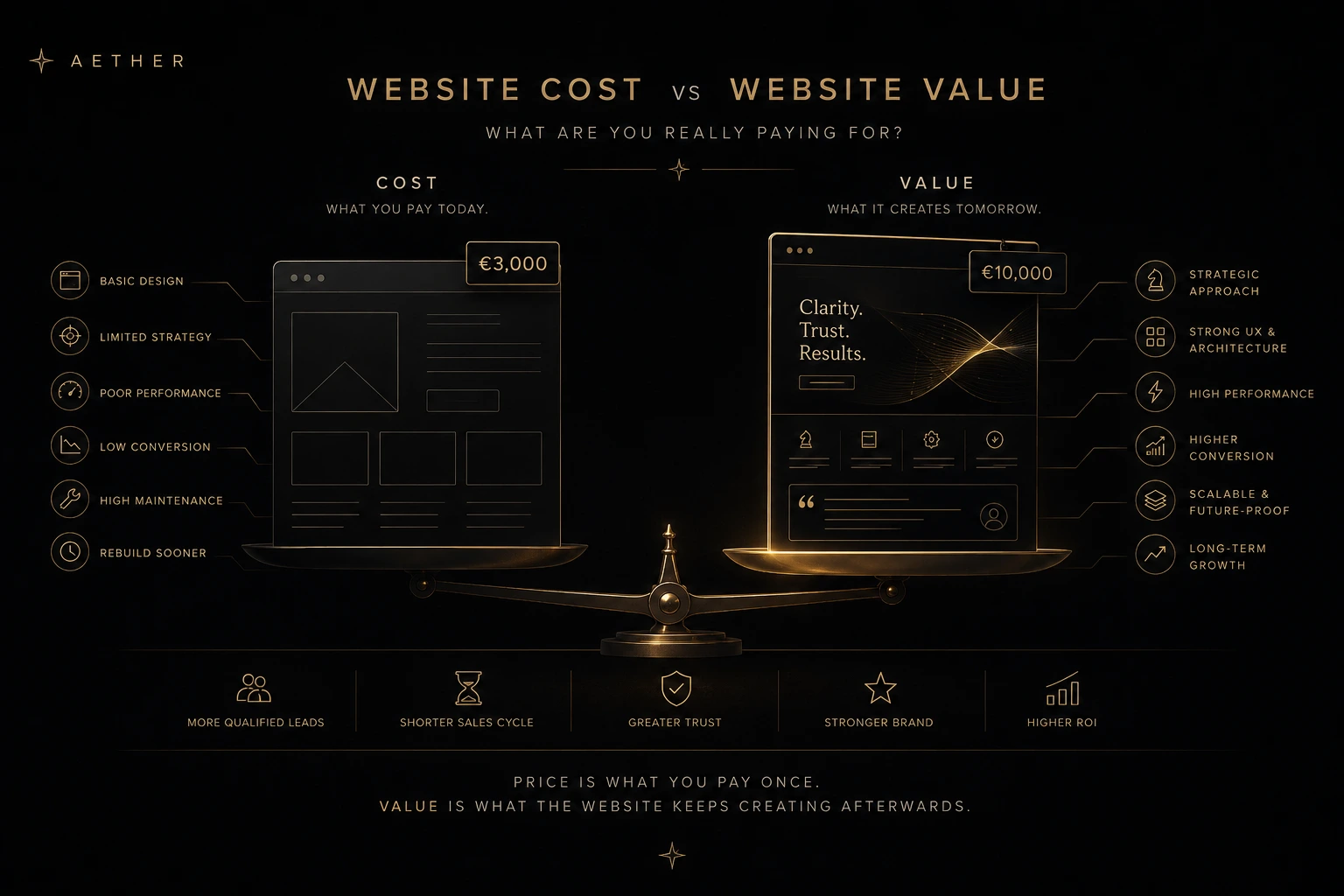
Two businesses invest in a new website.
The first spends €3,000.
The second spends €10,000.
Which one made the better decision?
Most people instinctively look at the price.
But price tells us almost nothing.
If the €3,000 website generates no meaningful enquiries, requires constant fixes and needs replacing three years later, was it really cheaper?
And if the €10,000 website attracts qualified leads, strengthens the sales process and continues supporting the business for seven years, was it really more expensive?
This is where conversations about website pricing often go wrong.
Businesses compare cost.
They rarely compare value.
Yet those are two completely different things.
Cost describes what leaves your bank account today.
Value describes what the investment creates tomorrow.
And when your website plays a serious role in attracting customers, building trust and supporting growth, that difference becomes far more important than the original invoice.
Website Cost Is Easy to Measure. Website Value Isn’t.
A quotation gives you a number.
€2,500.
€5,000.
€15,000.
That number is concrete.
Easy to compare.
Easy to discuss.
Value is less obvious.
How much is an additional qualified enquiry worth?
What is the value of shortening your sales process?
What does stronger credibility contribute over five years?
How much advertising budget is wasted when visitors arrive on a website that doesn’t convert?
What is it worth when potential customers understand your business before the first conversation even begins?
Those figures rarely appear on a web design proposal.
But they’re often significantly larger than the development cost itself.
That’s why our guide to how much a professional website costs starts with a different question: what does your business actually need the website to achieve?
Without answering that, comparing prices is little more than comparing numbers without understanding what they represent.
The Cheapest Website Can Produce the Lowest Return
Saving money is not a bad business decision.
Paying for things you don’t need is.
But choosing the lowest website quote simply because it’s the lowest can create a different problem.
You optimise the investment for launch day.
Not for everything that happens after launch.
A cheaper website may require compromises in:
Strategy.
Research.
UX.
Content structure.
Performance.
Scalability.
Technical quality.
Search foundations.
Individually, each compromise can appear small.
Together, they determine how effectively the website performs as a business asset.
This is exactly why we explored the hidden economics behind low-budget development in The Cost of a Cheap Website: Why Saving Money Often Costs More.
A cheap website doesn’t become expensive because someone charged too little.
It becomes expensive when the original saving creates larger costs later.
Rebuilding.
Maintenance.
Lost leads.
Poor advertising performance.
Limited growth.
Those are business costs.
Not design costs.
Website Value Begins With What the Website Is Built to Do
Not every business needs the same website.
A local consultant may need credibility and qualified enquiries.
An e-commerce company needs product discovery, trust and efficient checkout journeys.
A B2B organisation may need educational content that shortens a complex buying process.
An international brand may need multilingual architecture, integrations and scalable content systems.
The value of the website depends on how successfully it performs that role.
That is why professional web development should never begin with:
“How many pages do you need?”
It should begin with:
“What does this website need to change for the business?”
Once that outcome is understood, design decisions become much easier to justify.
UX has a purpose.
Performance has a purpose.
Content has a purpose.
Technology has a purpose.
This is also why a strategically built Custom Website can create far more value than simply paying for additional design hours.
The investment is not in prettier pages.
It’s in a digital system designed around a specific business outcome.
Good UX Creates Value Before a Visitor Ever Becomes a Customer
Website value isn’t created only when someone submits a form.
It starts much earlier.
A visitor understands what you do immediately.
Value.
They find the right service without searching.
Value.
They understand your process before contacting you.
Value.
They already trust your expertise when the sales conversation begins.
Value.
These improvements influence the entire commercial journey.
As we explained in Why Beautiful Websites Still Fail: The Hidden Power of UX Architecture, aesthetics create attention, but architecture determines whether visitors understand enough to move forward.
That understanding has financial value.
If your team spends less time explaining basic questions, the website creates operational value.
If more visitors become qualified leads, it creates conversion value.
If customers arrive with greater confidence, it creates sales value.
The website doesn’t need to complete the entire sale itself.
It needs to make everything that follows easier.
Performance Turns Marketing Spend Into More—or Less—Value
Imagine paying for one thousand visitors.
Google Ads.
Meta.
LinkedIn.
Organic content.
However they arrive, acquiring attention costs money.
Now imagine sending those visitors to a website that loads slowly, shifts during loading or makes important information difficult to find.
You haven’t only created a technical problem.
You’ve reduced the value of every euro spent acquiring those visitors.
This is why we describe poor digital experiences through the concept of Digital Friction™.
In Why Website Speed Matters More Than Ever, we explain how even small interruptions can weaken momentum throughout the customer journey.
The principle becomes
Long-Term Value Comes From Scalability
A website should not become obsolete simply because your business becomes more successful.
Yet that is exactly what happens to many companies.
The business grows.
The website does not.
New services need to be added.
Marketing becomes more sophisticated.
New integrations are required.
Content expands.
Different customer journeys emerge.
Suddenly, what once looked like a perfectly adequate website begins creating limitations.
That is where scalability becomes part of website value.
A scalable website allows the business to evolve without constantly rebuilding the foundation underneath it.
New functionality can be added.
New markets can be entered.
New landing pages can be created.
New campaigns can be supported.
The architecture adapts.
As we explored in Why a Custom WordPress Website Beats Any Template, custom development becomes valuable when flexibility starts generating more value than short-term convenience.
The best website investment is rarely the one that only solves today’s problem.
It is the one that gives tomorrow’s opportunities somewhere to grow.
Website ROI Is Bigger Than Direct Sales
When businesses think about return on investment, they often ask one question:
“How many customers did the website generate?”
That matters.
But it is only one part of the equation.
A website can create value in many different ways.
It can reduce the time your sales team spends answering repetitive questions.
It can qualify potential clients before the first conversation.
It can increase conversion rates from existing traffic.
It can strengthen organic visibility.
It can improve the performance of paid campaigns.
It can support recruitment.
It can build credibility before anyone contacts your business.
It can help artificial intelligence understand and recommend your expertise.
All of these outcomes have economic value.
The website becomes part salesperson.
Part educator.
Part brand platform.
Part marketing infrastructure.
That is why measuring website ROI only through immediate sales can dramatically underestimate the value the website creates across the rest of the organisation.
A Real-World Example
Imagine two specialist consulting firms.
Both generate approximately €1 million in annual revenue.
Both decide to replace outdated websites.
The first company receives two proposals.
One for €4,000.
One for €12,000.
They choose the €4,000 option.
The website looks modern.
It contains all the expected pages.
The project launches on time.
The second company chooses the more strategic investment.
Before design begins, customer journeys are mapped.
Content is reorganised around actual client questions.
Performance is treated as part of the experience.
Case studies are integrated into the decision journey.
SEO and AIO foundations are considered during architecture.
Both websites look professional.
But over the next three years, the difference becomes increasingly visible.
The first business continues spending money to attract traffic.
Conversion rates barely change.
New campaigns require awkward workarounds.
The website slowly becomes another system the team needs to manage.
The second website begins doing more of the work.
Prospects arrive better informed.
Marketing campaigns convert more effectively.
New content strengthens search visibility.
Service pages can be expanded without redesigning the entire platform.
The €12,000 website did not become more valuable because it cost more.
It became more valuable because the investment was directed towards outcomes.
That is the difference between cost and value.
The AETHER Perspective
At Bureau AETHER, we do not believe every company needs the most expensive website it can afford.
We believe every company needs the right digital foundation for where it wants to go.
Sometimes that means starting small.
Sometimes that means investing more before limitations become expensive.
The important question is never:
“How much design can we fit into this budget?”
It is:
“Which investment creates the strongest long-term business outcome?”
That is why our Custom Website Development process starts with strategy rather than page count.
Who needs to use the website?
Which decisions need to become easier?
Where is Digital Friction™ currently reducing performance?
What should the website make possible in three or five years?
How should it support marketing, SEO and AI-powered discovery?
Those questions determine value.
Only then do design and technology enter the conversation.
And when businesses want the website to become part of a broader acquisition engine, a connected Digital Marketing strategy allows the value of that foundation to compound through content, visibility and customer acquisition.
Conclusion & Final Thought
Website cost is visible immediately.
Website value reveals itself over time.
That is why price comparisons alone are so misleading.
Two websites can look almost identical on launch day.
Five years later, one may have become an expensive limitation.
The other may have become one of the most valuable assets in the business.
The difference is not determined by how much money was spent.
It is determined by what that investment was designed to achieve.
Price is what you pay once.
Value is what the website keeps creating afterwards.
If your website is expected to generate trust, support marketing and grow alongside your business, explore our Custom Website Development approach or discover how SEO & AIO can turn that digital foundation into long-term discoverability and authority.