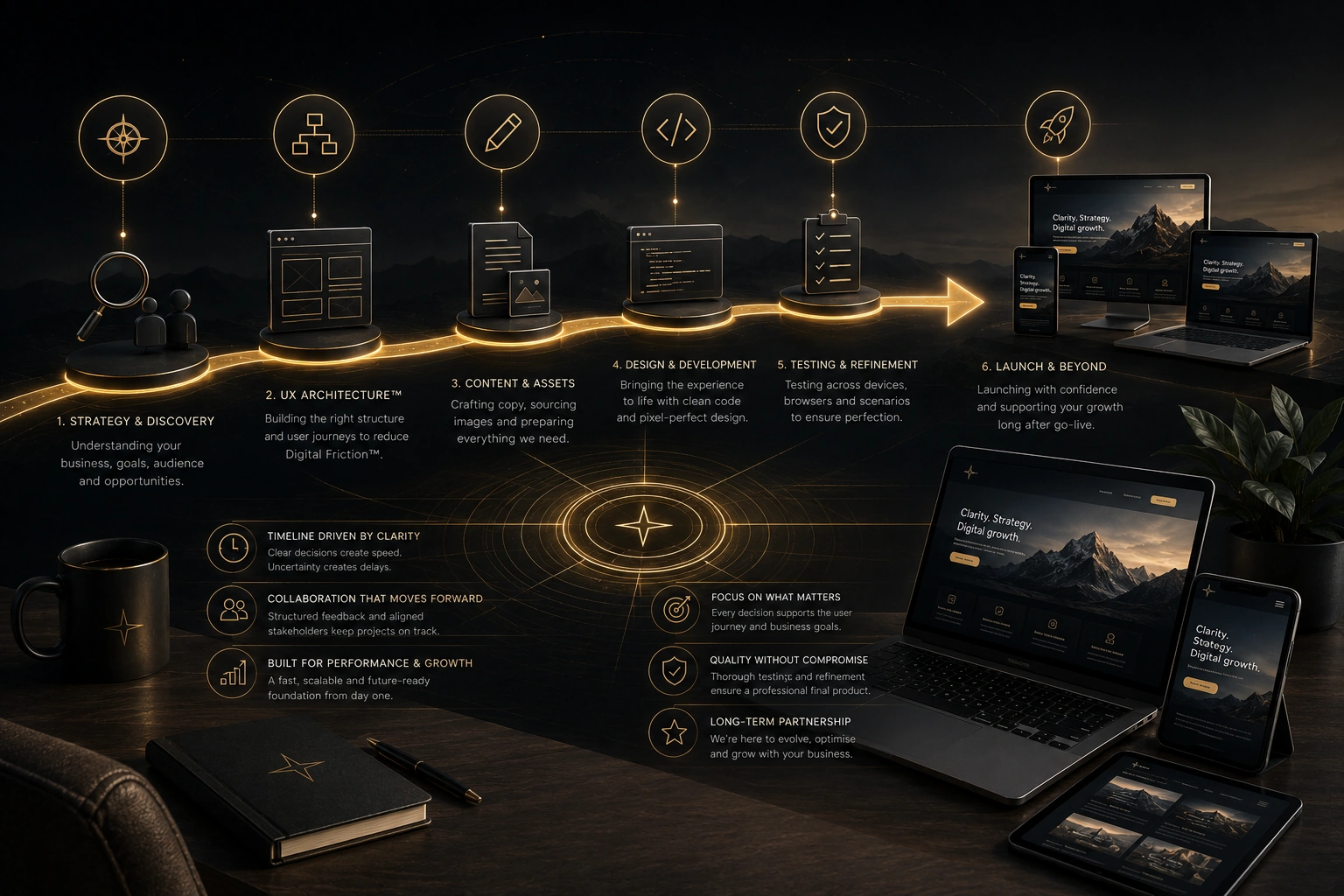
One of the most common questions businesses ask before starting a website project is simple:
“How long does it take to build a professional website?”
The answer can be anywhere from a few weeks to several months.
And that difference is not necessarily caused by how many pages the website has.
A ten-page website can take longer to build than a fifty-page website.
A visually simple website can require more strategic work than a highly designed one.
A project can move quickly when decisions are clear.
Or slowly when content, feedback and objectives remain uncertain.
That is why website timelines are often misunderstood.
Businesses tend to measure a website by what becomes visible.
Pages.
Designs.
Animations.
Features.
But much of the work that determines whether the website succeeds happens before those things are built.
Strategy.
Research.
UX Architecture™.
Content.
Technical planning.
Testing.
Search foundations.
A professional website is not simply assembled.
It is developed through a sequence of decisions.
And the quality of those decisions usually matters more than how quickly the first homepage appears.
Most Professional Websites Take Between Several Weeks and Several Months
There is no universal website development timeline.
But most professional business websites fall somewhere between several weeks and several months.
A relatively straightforward website may move quickly when:
The business already has clear positioning.
The content exists.
The page structure is simple.
Few integrations are required.
Decision makers are available.
Feedback arrives quickly.
A more complex project naturally takes longer.
Especially when it includes:
Custom UX.
Large content structures.
Multiple customer journeys.
Custom functionality.
Third-party integrations.
E-commerce.
Multilingual content.
SEO migrations.
Advanced performance requirements.
The important distinction is that a longer timeline is not automatically better.
And a faster timeline is not automatically more efficient.
The right timeline is the one that gives the project enough space to make the necessary decisions without adding unnecessary process.
The Timeline Should Start Before Design
Many businesses assume the project begins when the designer starts creating screens.
In a professional website project, that should happen later.
First comes understanding.
What does the business need the website to achieve?
Who are the priority audiences?
Which services matter most?
Where does the current website create Digital Friction™?
Which content needs to exist?
How will the website support marketing?
What functionality is required now?
What might be required later?
These questions influence everything that follows.
If they are skipped, design may begin faster.
But development often becomes slower later because fundamental decisions keep changing.
This is one reason our Custom Website Development process begins with strategy and architecture rather than immediately moving into visual design.
A few days spent creating clarity early can prevent weeks of revisions later.
Strategy Determines What Actually Needs to Be Built
Before estimating development time accurately, the scope needs to become clear.
This sounds obvious.
But website scope is often described too simply.
“We need ten pages.”
That tells a development team very little.
Are those ten pages based on one reusable structure?
Or ten completely different customer journeys?
Do they require original copy?
Custom illustrations?
Interactive functionality?
CRM integrations?
Search migration?
Multiple languages?
Different user permissions?
The number of pages is only one dimension.
The complexity of the decisions behind those pages matters far more.
This connects directly with the distinction we made in How Much Does a Professional Website Cost?.
Website price and website timeline are influenced by many of the same factors.
Complexity.
Strategy.
Content.
Functionality.
Technical requirements.
The clearer those factors are before production begins, the more reliable both the budget and timeline become.
UX Architecture™ Often Saves Time Later
UX planning can look like an additional stage.
In reality, it often removes unnecessary work.
Without clear UX Architecture™, teams may begin designing individual pages before understanding how those pages should connect.
Then problems appear.
The navigation changes.
Services need reorganising.
Calls to action move.
Content no longer fits.
Page designs need to be rebuilt.
Development starts before the experience is stable.
Every late structural change becomes more expensive than an early one.
UX Architecture™ reduces that risk by answering fundamental questions before detailed design begins.
What does the visitor need first?
Which information belongs together?
Which paths should exist?
Where does uncertainty appear?
What should happen next?
As we explain in Why Beautiful Websites Still Fail, the structure of an experience determines far more than its appearance.
It also determines how efficiently that experience can be designed and built.
Content Is One of the Biggest Causes of Website Delays
Development is rarely the only thing controlling a website timeline.
Content often creates the biggest delays.
Copy is still being written.
Photography has not been selected.
Case studies are incomplete.
Service descriptions are being rewritten.
Team information is missing.
Legal pages still need approval.
Suddenly, the website is technically ready but cannot launch.
This is why content should not be treated as something that gets inserted after design.
Content influences design.
Design influences hierarchy.
Hierarchy influences the user journey.
They are connected.
A five-word heading creates a different layout from a twenty-word heading.
A service with extensive educational content needs a different structure from one that requires only a short explanation.
Case studies need space in the architecture before they can support decision-making effectively.
Planning content early makes both design and development more predictable.
It also creates a stronger foundation for future SEO & AIO, because important topics and relationships can be considered before the website structure becomes fixed.
Development Time Depends on What the Website Needs to Do
Once strategy, architecture and content are clear, development becomes much easier to estimate.
But technical scope still matters.
A simple lead-generation website may only require a small number of reusable components.
A more advanced platform may need:
Custom post types.
CRM integrations.
Advanced forms.
Booking systems.
E-commerce.
Dynamic filtering.
Multilingual functionality.
Membership systems.
Custom APIs.
Each additional system introduces decisions.
How should it behave?
What happens when something fails?
How does it affect performance?
How should it behave on mobile?
How easy should it be for the internal team to manage?
These questions influence development time far more than the visual size of the website.
This is also why custom development only makes sense when the extra flexibility creates meaningful value.
Complexity should always have a reason.
Testing Is Part of the Build, Not Something That Happens After It
A website is not finished when the final page has been developed.
It still needs to be tested.
Desktop.
Mobile.
Different screen sizes.
Different browsers.
Forms.
Links.
Interactions.
Performance.
Accessibility.
Search foundations.
Tracking.
Redirects.
Integrations.
Testing often looks invisible from the outside.
But it is one of the stages that separates a professional launch from a rushed one.
A small issue discovered before launch may take minutes to solve.
The same issue discovered after thousands of visitors arrive can create lost leads, broken campaigns or unnecessary support work.
This is why professional timelines need room for validation.
Not because agencies want to delay launch.
Because reliability is part of the product.
Feedback Can Accelerate or Slow Down the Entire Project
Even the best development process depends on decisions.
If feedback arrives quickly and clearly, a project can move efficiently.
If feedback is fragmented across several stakeholders, progress can slow dramatically.
One person prefers one direction.
Another changes the objective.
A third enters the project late.
Previously approved decisions are reopened.
The development team is then forced to revisit work that was already complete.
This is not always avoidable.
Businesses need internal alignment.
But a professional website process should make that alignment easier.
Clear milestones help.
Defined decision makers help.
Structured feedback helps.
Approving architecture before visual design helps.
Approving design before full development helps.
The goal is to reduce unnecessary loops.
Good project management does not remove collaboration.
It gives collaboration structure.
A Real-World Example
Imagine two businesses commissioning websites of similar size.
Both need around fifteen pages.
Both require a custom design.
Both use WordPress.
On paper, the projects look almost identical.
The first company begins with clear positioning.
Its service structure is already understood.
One stakeholder is responsible for final decisions.
Most content is prepared before development begins.
Feedback is consolidated internally.
The project moves from strategy to architecture, design, development and testing without repeatedly reopening earlier decisions.
The second company begins without clear positioning.
Services are reorganised halfway through design.
Copy arrives after pages have already been built.
Several stakeholders provide conflicting feedback.
A new integration is introduced shortly before launch.
The page count is almost identical.
The timeline is not.
This is why asking how long a website takes based purely on size can be misleading.
The speed of a project depends heavily on how quickly uncertainty can be removed.
The AETHER Perspective
At Bureau AETHER, we do not believe the best website project is the fastest one.
Nor do we believe long timelines automatically create better work.
Efficiency comes from sequencing decisions correctly.
Strategy before structure.
Structure before detailed design.
Design before development.
Development before validation.
Validation before launch.
That sequence reduces Digital Friction™ inside the project itself.
It prevents teams from investing deeply in decisions that may still change.
It also makes the timeline easier to understand.
When we approach Custom Website Development, the objective is not to extend the project unnecessarily.
It is to spend time where that time creates value.
A simple requirement should remain simple.
A complex requirement should be understood before it becomes expensive.
And the final website should launch because it is ready.
Not simply because the calendar says it should.
Conclusion & Final Thought
So, how long does it take to build a professional website?
There is no universal answer.
A focused project can move in several weeks.
A complex platform may require several months.
The timeline depends on much more than page count.
Strategy.
Content.
UX Architecture™.
Functionality.
Integrations.
Feedback.
Testing.
All of them matter.
But the biggest factor is usually clarity.
The sooner the right decisions are made, the faster the right website can be built.
Rushing past those decisions may shorten the beginning of the project.
It often makes everything afterwards take longer.
If you are planning a new website and want a development process built around clear decisions, efficient execution and long-term value, explore our Custom Website Development approach.