A custom website sounds like the premium option.
More flexibility.
More control.
More possibilities.
And usually a larger investment.
So the obvious question is:
Is a custom website actually worth it?
The answer is not always yes.
A startup testing its first idea may be perfectly served by a well-designed template.
A small local business may not need complex custom functionality.
And investing heavily in technology before the business model is proven can create cost without creating meaningful value.
But there comes a point where the question changes.
You stop asking whether a template is cheaper.
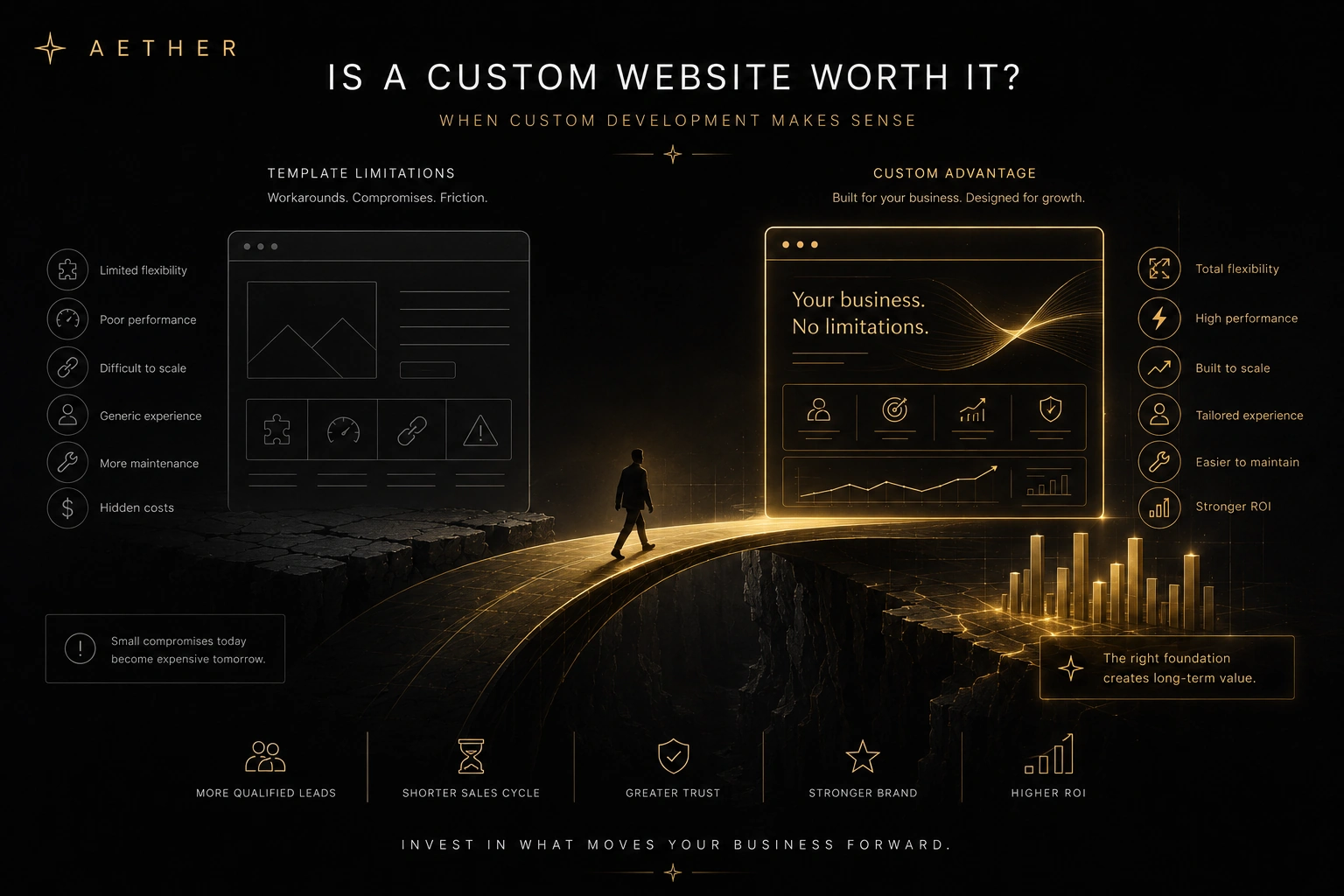
You start asking whether its limitations are beginning to cost the business more than custom development would.
That is the point where a custom website starts making sense.
Not because custom is automatically better.
Because the website has become important enough that compromises in performance, user experience, scalability or marketing begin affecting business outcomes.
A Custom Website Is Not the Right Choice for Every Business
Custom development should solve a problem.
It should not exist simply because custom sounds more professional.
There are situations where an existing theme or template is the smarter decision.
If the website only needs a few simple pages.
If the business is still validating its market.
If traffic is limited.
If functionality is straightforward.
If the website is not yet central to customer acquisition.
In those situations, simplicity can be valuable.
A good template can provide a professional digital presence without requiring a large initial investment.
The mistake is not choosing a template.
The mistake is expecting a template to continue serving the business after the requirements have fundamentally changed.
As we explained in Why a Custom WordPress Website Beats Any Template, templates are often designed to solve common problems for many different businesses.
That is exactly what makes them useful.
And eventually, exactly what creates their limitations.
Custom Development Becomes Valuable When Compromise Becomes Expensive
Most businesses do not suddenly wake up needing a custom website.
The need develops gradually.
A new service does not fit naturally into the existing structure.
A landing page requires another workaround.
The marketing team wants functionality the theme was never designed to support.
Performance begins declining as plugins accumulate.
Navigation becomes increasingly complicated.
Content grows without a clear architecture.
Small compromises start appearing everywhere.
At first, each one seems manageable.
Together, they create Digital Friction™.
Not only for visitors.
For the business itself.
Teams spend more time maintaining the website.
Marketing ideas become harder to execute.
Developers work around limitations rather than building useful functionality.
Growth starts depending on what the existing website allows.
That relationship should be reversed.
The website should support the business.
The business should not have to organise itself around the limitations of the website.
This is where custom development starts creating value.
The Real Advantage of Custom Development Is Control
Custom does not simply mean unique colours and layouts.
Visual design is only one layer.
The deeper advantage is control.
Control over architecture.
Control over performance.
Control over functionality.
Control over the customer journey.
Control over how the website evolves.
Instead of starting with what a template provides, you start with what the business needs.
That changes the entire development process.
The navigation can reflect the way customers actually search for information.
Pages can be structured around real decision journeys.
Functionality can support internal processes instead of forcing generic workflows.
Performance decisions can be made intentionally.
SEO and AIO can be considered at the architectural level.
The website becomes a system built around the organisation rather than an organisation squeezed into a predefined system.
That is the philosophy behind our Custom Website Development approach.
We do not begin by asking which layout a client prefers.
We begin by understanding what the website needs to make possible.
A Custom Website Can Create More Value From the Traffic You Already Have
Businesses often assume growth requires more visitors.
More SEO.
More advertising.
More content.
Sometimes it does.
But traffic is only valuable when the experience after the click works.
Imagine two companies attracting the same 10,000 visitors.
One website makes the next step obvious.
The other creates uncertainty.
One establishes trust quickly.
The other forces visitors to search for basic information.
One guides different customer types towards relevant services.
The other presents everyone with the same generic journey.
The traffic is identical.
The business value is not.
This is where UX Architecture™ becomes commercially important.
A custom website allows the customer journey to be designed around actual behaviour rather than the assumptions built into a generic layout.
That can improve the value of SEO.
The value of advertising.
The value of content.
And ultimately the value of every visitor reaching the website.
Before spending more money acquiring attention, businesses should ask whether their existing digital experience is extracting enough value from the attention they already have.
Custom Development Makes More Sense as the Business Becomes More Complex
Growth changes what a website needs to do.
A five-page brochure website may be perfectly suitable when a company is small.
Then the business expands.
More services appear.
Different audiences need different information.
New markets are entered.
Marketing campaigns require dedicated landing pages.
CRM systems need to connect with forms.
Recruitment becomes important.
Content becomes part of the acquisition strategy.
Suddenly, the website is no longer simply presenting the company.
It is coordinating multiple parts of the business.
This is where generic architecture often starts breaking down.
Custom development allows the digital platform to evolve around that complexity rather than continuously hiding it behind additional plugins, duplicated pages and temporary solutions.
The larger the role your website plays in the business, the more valuable architectural flexibility becomes.
This is also where website cost needs to be viewed differently.
As we explored in Website Cost vs Website Value, the relevant question is not simply how much a website costs to build.
It is how much value that website can continue creating as the organisation grows.
Performance Becomes More Important When Your Website Starts Making Money
A slow website is frustrating when you have a hundred visitors.
It becomes expensive when you have ten thousand.
The commercial importance of performance increases alongside traffic.
Every campaign sends people somewhere.
Every organic ranking generates visits.
Every social post creates another potential journey through the website.
If that destination is slow or unstable, part of the investment used to generate that traffic is immediately weakened.
This is one reason custom development can become worthwhile for businesses with serious acquisition strategies.
You gain greater control over what gets loaded.
Which functionality is necessary.
How templates are structured.
How content is delivered.
And how performance is protected as the website becomes more complex.
Our article on why website speed matters more than ever explores the connection between performance, trust and Digital Friction™ in greater depth.
The principle is simple.
The more valuable your traffic becomes, the more expensive a poor experience becomes.
Custom Architecture Also Creates a Stronger Foundation for Search and AI
Modern websites are not interpreted only by human visitors.
Search engines analyse their structure.
AI systems interpret relationships between entities, services, expertise and content.
As a website grows, clear architecture becomes increasingly important.
Which topics belong together?
How are services connected?
Which pages demonstrate expertise?
What does the organisation actually specialise in?
A website built purely around visual templates can answer these questions poorly.
A strategically structured website can make those relationships much clearer.
That does not mean custom development automatically produces better rankings.
It means custom architecture gives you greater control over the foundation on which SEO and AIO strategies operate.
Semantic structure can be considered from the beginning.
Content hierarchies can reflect genuine expertise.
Internal linking can support a coherent knowledge ecosystem.
Structured data can be implemented where appropriate.
Technical decisions can support discoverability rather than working against it.
For businesses that increasingly depend on organic and AI-powered discovery, our SEO & AIO approach connects this technical foundation with the broader strategy required to build long-term Semantic Authority™.
As we explain in What Is AIO?, visibility is increasingly about becoming understandable enough to be discovered, trusted and referenced.
A Real-World Example
Imagine a specialist engineering company.
When the company launched, it offered three services in one region.
A template-based website worked perfectly well.
It was fast enough.
Easy to manage.
Affordable.
And appropriate for the stage of the business.
Five years later, the situation is different.
The company now serves several industries.
It operates internationally.
It publishes technical insights.
It runs paid campaigns.
Its sales team needs sector-specific landing pages.
Prospects require different information depending on project type.
The original website still works.
Technically.
But nearly every new initiative requires compromise.
Pages are duplicated because the existing structure cannot support different journeys.
Plugins are added to solve individual problems.
Marketing depends increasingly on developer workarounds.
The company has not necessarily outgrown WordPress.
It has outgrown the assumptions of the original website.
A custom rebuild now makes sense because the business has become valuable enough for those limitations to matter.
The investment is not justified because custom development is more prestigious.
It is justified because removing those constraints creates measurable operational and commercial value.
The AETHER Perspective
At Bureau AETHER, we believe custom development should be earned by the requirements of the business.
Not sold by default.
If a template can solve the problem elegantly, efficiently and sustainably, there is little value in making the project more complicated.
But when a website becomes central to acquisition, credibility, operations or growth, the economics begin to change.
Every limitation carries a cost.
Every unnecessary workaround creates Digital Friction™.
Every architectural compromise makes future development slightly harder.
At that point, custom development becomes less about having something unique.
It becomes about having something appropriate.
A platform shaped around your customer journey.
Your content.
Your marketing.
Your technology.
Your ambitions.
That is how we approach Custom Website Development.
We do not ask how much customisation we can sell.
We ask where greater control can create greater value.
Conclusion & Final Thought
So, is a custom website worth it?
Sometimes.
And that qualification matters.
A business should not invest in custom development simply because custom sounds better.
It should invest when the website has become important enough that generic limitations begin restricting performance, marketing, user experience or growth.
That point looks different for every organisation.
For one company, it may arrive when a template can no longer support the customer journey.
For another, when performance begins reducing the return from advertising.
For another, when expanding content and services create architectural complexity.
The common factor is not company size.
It is dependency.
The more your business depends on its website, the more valuable control over that website becomes.
Custom development makes sense when the value of removing limitations becomes greater than the cost of building beyond them.
If your current website is beginning to dictate what your business can and cannot do, explore our Custom Website Development approach and discover what a digital foundation designed around your business could make possible.